
Buying Guides
Electric Wheelchair vs Mobility Scooter: Which Is Right for You? (UK Guide 2026)
16 March 2026 · 7 min read
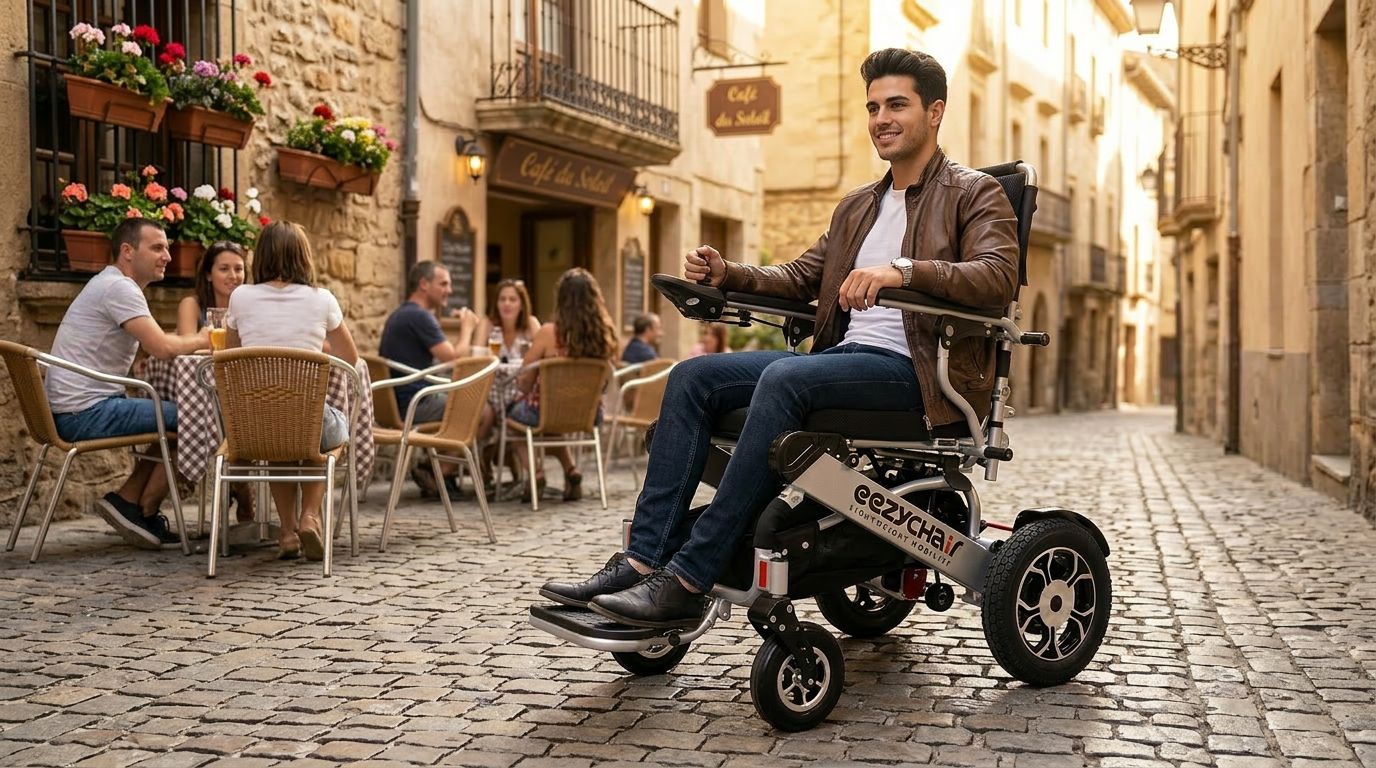
Electric Wheelchair vs Mobility Scooter — What's the Real Difference?
If you're looking for powered mobility in the UK, the two most common options are electric wheelchairs (also called powerchairs) and mobility scooters. They might seem similar on the surface, but they're designed for very different needs.
This guide compares both options across the factors that actually matter day-to-day — so you can make the right choice for your lifestyle.
At a Glance: Key Differences
| Feature | Electric Wheelchair | Mobility Scooter |
|---|---|---|
| Steering | Joystick (one hand) | Tiller / handlebars (two hands) |
| Indoor use | Excellent — tight turning circle | Limited — wide turning radius |
| Car boot fit | Folding / splitting models fit easily | Often too large or heavy |
| Airline travel | Usually approved (under 300 Wh) | Rarely accepted by airlines |
| Seating | Adjustable, supportive | Basic bench-style seat |
| Posture support | High — back, arms, footrest | Minimal |
| Pavement classification | Class 2 (4 mph pavement) | Class 2 or Class 3 (8 mph road) |
| Typical weight | 20–35 kg (folding models) | 40–120 kg |
| Price range | £800–£5,000 | £500–£4,000 |
When an Electric Wheelchair Is the Better Choice
You need indoor and outdoor versatility
Electric wheelchairs have tight turning circles — often under 80 cm — which means they work inside homes, shops, restaurants, and lifts. Most mobility scooters simply can't navigate these spaces.
You travel by car regularly
The EEZY SPLIT separates into two sections for loading. Designed to suit most hatchback, estate and SUV boots. Always check the folded dimensions against your vehicle. Whether you need a ramp or hoist depends on your lifting ability and vehicle.
You fly or take trains
Two removable 144Wh lithium batteries — check with your airline before travelling. Airline acceptance and handling requirements are always subject to the individual airline. Read our full airline guide for preparation advice.
You have limited upper body strength
A joystick requires only minimal finger movement. Scooter tillers demand grip strength, arm control, and the ability to steer — which isn't suitable for everyone.
You need postural support
Electric wheelchairs offer adjustable backrests, armrests, and footrests. If you have a condition that affects your posture or balance, a wheelchair provides far better support than a scooter's basic seat.
When a Mobility Scooter Might Be Better
You mainly travel longer outdoor distances
Class 3 mobility scooters can travel at up to 8 mph on roads and often have a longer range (up to 30 miles) than most electric wheelchairs. If your primary need is covering distance outdoors, a scooter may suit you.
You have good upper body strength and balance
If you can comfortably grip handlebars, steer, and sit upright without support, a scooter's simpler controls may feel more natural.
You don't need to take it indoors often
If you'll mainly use it outside — parks, pavements, shopping centres — and don't need to navigate narrow hallways or doorframes, a scooter's larger footprint is less of an issue.
Car Boot Portability: The Deciding Factor for Many
For UK users, the biggest practical difference often comes down to how you get it to where you need it.
- Folding electric wheelchairs collapse in seconds. The EEZY SPLIT separates into two sections — the front is 19.2 kg with both batteries fitted (16 kg without them) and the rear is 10.3 kg. Designed to suit most hatchback, estate and SUV boots. Always check the folded dimensions against your vehicle.
- Mobility scooters — even "boot scooters" — tend to be heavier and bulkier. Many still need disassembly, and the heaviest pieces can weigh 20–30 kg.
If you rely on a car for most journeys, a folding electric wheelchair is almost always the more practical option. See our car boot wheelchair guide for a deeper dive.
Cost Comparison in the UK
Both options span a wide price range, but here's what matters:
- Budget mobility scooters start around £500, but quality and durability vary enormously.
- Quality electric wheelchairs start from around £800–£1,200. The Eezy Split is £795 VAT exempt — one of the best-value folding powerchairs available.
- VAT exemption applies to both if you have a chronic illness or disability. This saves 20% immediately. Learn more about VAT relief.
Running costs
Both types have similar running costs — mainly battery charging (pennies per charge) and occasional tyre or battery replacement. Electric wheelchairs tend to have simpler maintenance since there's no tiller mechanism or steering column to service.
NHS and Funding Options
The NHS wheelchair services provide powered wheelchairs to those who qualify, but the process can take months and the range of chairs available is limited. Mobility scooters are not provided by the NHS.
Other funding sources for either option include:
- Motability Scheme — available for both (if you receive qualifying benefits)
- Charitable grants — organisations like the Family Fund or local disability charities
- Access to Work — if you need powered mobility for employment
What About Off-Road Use?
If you need to handle grass, gravel, or uneven terrain, not all options are equal:
- Electric wheelchairs with large pneumatic tyres and suspension (like the Eezy Split's 12-inch rear tyres and front spring suspension) handle rough ground well. Read our off-road electric wheelchair guide.
- Mobility scooters — larger Class 3 models with pneumatic tyres can handle rough terrain, but smaller boot scooters with solid tyres struggle on anything uneven.
Frequently Asked Questions
Can I use a mobility scooter indoors?
Some smaller scooters can be used indoors, but their wide turning circle makes navigating hallways, kitchens, and lifts difficult. An electric wheelchair is almost always better for indoor use.
Is an electric wheelchair safer than a scooter?
Both are safe when used correctly. However, electric wheelchairs offer better postural support and stability, especially for users with limited balance or trunk control.
Can I take a mobility scooter on a plane?
Airline acceptance depends on the device, its battery configuration and the individual carrier. Confirm the battery rating, dimensions and handling requirements with your airline before travelling.
Which is better for a heavy person?
Most standard scooters support 100–150 kg. The Eezy Split electric wheelchair supports up to 180 kg, making it one of the best options for larger users. See our heavy-duty wheelchair guide.
The Verdict
For most UK users — especially those who need indoor–outdoor versatility, car boot portability, and travel-friendliness — a folding electric wheelchair is the better all-round choice.
If you mainly need to cover long outdoor distances and have good upper body strength, a mobility scooter could work well.
The Eezy Split bridges the gap: it's a full-featured electric wheelchair that folds, splits, handles off-road terrain, supports up to 180 kg, and costs just £795 VAT exempt with free next day delivery.